

ADA Door Hardware Requirements: Miami-Dade Compliance Guide

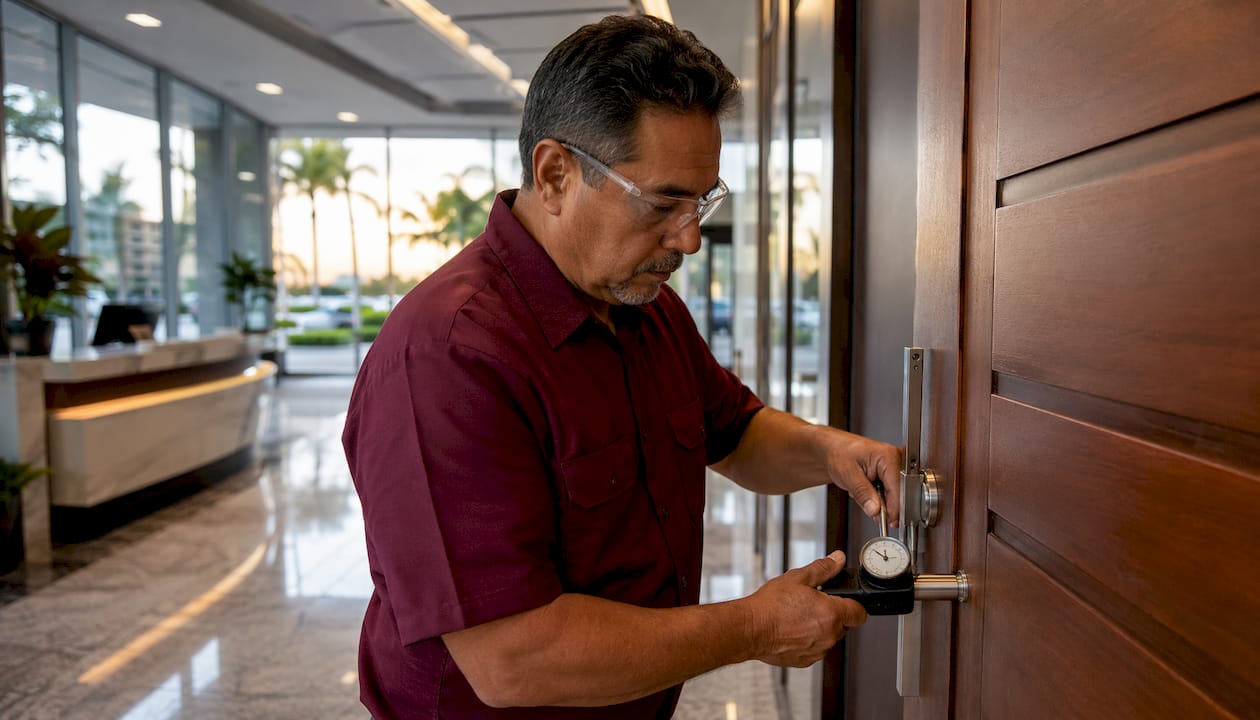
Any interior hinged door in a U.S. building must open with no more than 5 lbf of continuous force once the latch is retracted, and all operable hardware must work with one hand without tight grasping, pinching, or twisting. Those two rules, drawn from the 2010 ADA Standards for Accessible Design, cover the majority of compliance failures our technicians find on Miami-Dade properties.
Key requirements at a glance:
Opening force: 5 lbf maximum for interior hinged, sliding, and folding doors (latch retraction force is excluded from the measurement)
Hardware operation: One-hand operable; no simultaneous actions, no wrist twisting
Acceptable hardware: Lever handles, U-shaped pulls, push/pull bars, panic hardware
Non-compliant hardware: Round knobs (require wrist twisting and fail the functional test)
Mounting height: Hardware must be positioned within an accessibility-appropriate height range above the finished floor
Authority: U.S. Access Board, 2010 ADA Standards, ADA National Network
Table of Contents
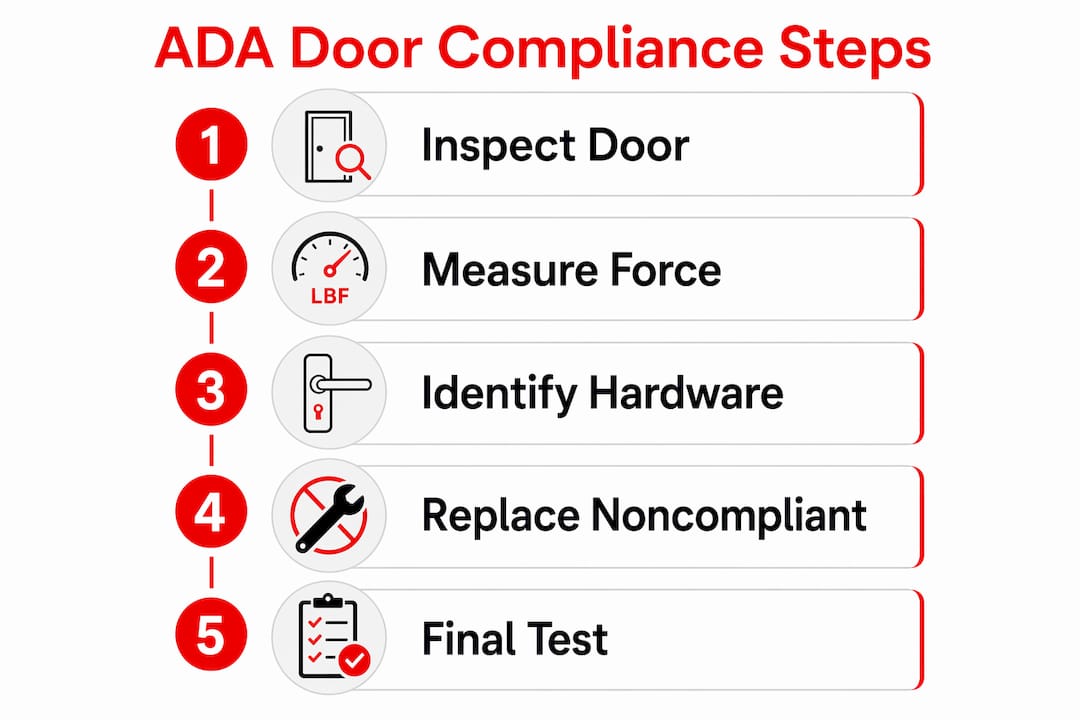
Run this 5-point ADA door check before you call anyone
Walk up to any interior hinged door and spend two minutes on these checks. You will know immediately whether to call a locksmith today or schedule work for next week.
Hardware shape. Can you push the lever down or pull the handle with a loose fist? If you need to grip and twist, it fails.
Visible binding. Watch the top corner of the door as it swings. A gap that opens and closes signals a hinge problem that adds resistance.
Latch operation. Push the door open slowly. If you feel a hard catch before the door moves freely, the latch or strike is misaligned and adding force to your reading.
Mounting height. Eyeball the handle center. Position of the handle outside of the typical accessibility range means it could be non-compliant.
Kick plate and bottom clearance. A smooth surface on the lower push side lets wheelchair users open the door without hardware contact.
Prioritize which doors to fix first: Start with primary public entrances and the highest-traffic corridors. Those are the doors most likely to be tested during an inspection and the ones that affect the most people daily.
A door that passes all five visual checks can still fail a force gauge test. Weatherstripping pressure, a stiff closer, and a dragging threshold each add resistance that is invisible to the eye but measurable with a gauge. Schedule a professional reading on any door that serves a public entrance or an accessible route.
How opening force is actually measured
Opening force is measured after the latch is fully retracted. The U.S. Access Board is explicit: latch retraction force and initial seal drag are excluded from the 5 lbf limit. Measuring with the latch still engaged is the single most common mistake property managers make when self-testing.
Step-by-step measurement:
Retract the latch bolt manually or hold the handle in the open position so the latch is fully clear of the strike.
Place a calibrated door-pressure gauge approximately 2½" from the latch edge of the door.
Apply steady, continuous force and push the door from its closed position to roughly 70°.
Record the peak force reading shown on the gauge.
Repeat twice and average the readings. Any average above 5 lbf is a failure.
Common measurement mistakes to avoid:
Measuring with the latch engaged (adds latch retraction force to the reading)
Placing the gauge at the center of the door (reduces mechanical advantage and understates force)
Testing when HVAC pressure differential is high (stack effect can temporarily inflate readings)
Not averaging multiple readings (a single test can be skewed by door position)
ANSI/BHMA A156.4 and ICC A117.1 provide complementary technical tolerances for closer measurement procedures; a licensed locksmith should reference these when documenting results for an inspection.
Pro Tip: Ask your locksmith to leave a written record showing the gauge model, the date, the door location, the three individual readings, and the average. That document is your proof of compliance during a building inspection or audit.
Hardware types: what usually fails and what to install instead
Round knobs are non-compliant under ADA compliance standards because they require wrist rotation to operate. The functional test is simple: if a person cannot open the hardware with a closed fist or loose grip, it fails.
Hardware type | Compliance likelihood | Notes |
Round knob | Non-compliant | Requires wrist twisting; replace immediately |
Lever handle | Compliant | Most common replacement; works with loose grip |
U-shaped pull | Compliant | Good for heavy commercial doors |
Push/pull bar | Compliant | Ideal for high-traffic commercial entries |
Panic hardware (crash bar) | Compliant | Required on many commercial egress doors |
Thumb-latch handle | Generally compliant | Acceptable if no simultaneous action required |
Small-part pin locks | Often non-compliant | Fails if pinching is required to operate |
What makes hardware fail the functional test:
Requiring two simultaneous hand movements (turn and push at the same time)
Any mechanism that demands fine motor control or finger dexterity
Hardware mounted outside the recommended height range for accessibility
For commercial properties, lever sets with a return-to-door design are the standard replacement. Residential doors often use passage levers or privacy levers. When planning a full door upgrade, reviewing available door styles alongside hardware selection helps avoid mismatches between the door slab and the new hardware prep.
What a locksmith will do to meet the opening-force standard
Replacing hardware alone often does not fix a high force reading. The 5 lbf limit applies to the entire door assembly once unlatched, so a technician must diagnose every component that adds resistance.
Inspect the door closer. Closers must allow at least 5 seconds from 90° to 12° from closed. An overtightened closer is the most common cause of excess opening force.
Check and lubricate hinges. Binding or dry hinges add measurable resistance. A technician will clean, lubricate, and tighten loose screws or replace worn hinges.
Adjust the strike and latch. A misaligned strike forces the latch to drag before it clears, adding force to the reading even after retraction.
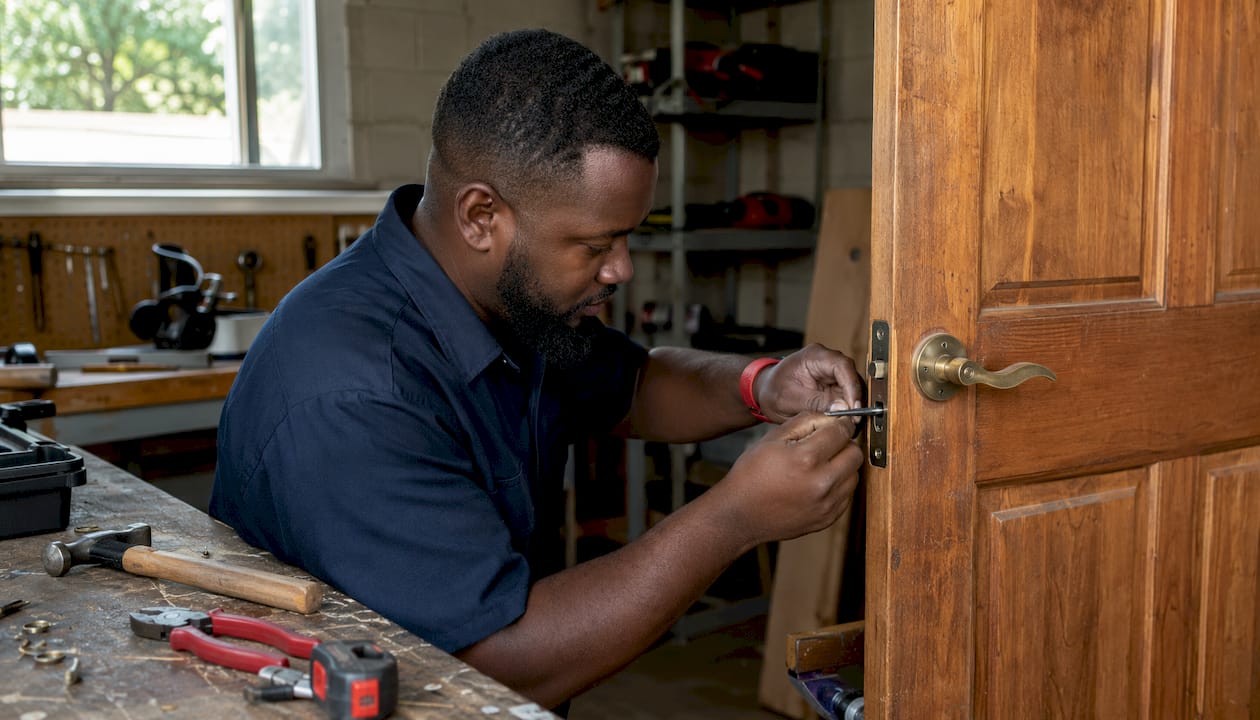
Replace non-compliant hardware. Swap round knobs for lever sets or appropriate pull hardware at the correct mounting height.
Test opening force with a gauge. Record readings before and after adjustments to confirm the door now meets the 5 lbf standard.
Document results. Photograph the hardware, note the gauge readings, and leave a written summary with the property manager.
Pro Tip: If the door still reads above 5 lbf after closer adjustment and hinge work, the problem is likely the threshold seal or door alignment. Those require carpentry or door-frame work beyond hardware adjustment alone. A good locksmith will tell you this on-site rather than close the job with a failing reading.
Concerned about DIY door replacement risks? They are real. Misaligned frames and improper closer installation are two of the most common reasons a door fails its first force test after a non-professional replacement.
When the 5 lbf rule applies and when it does not
The 5 lbf maximum applies to interior hinged, sliding, and folding doors on accessible routes. Two major categories are excluded.
Exterior doors are governed by model building codes, not the ADA opening-force rule. Those codes typically allow higher forces because exterior doors face wind load and weatherstripping demands that interior doors do not.
Fire doors are governed by fire code, which takes precedence over ADA opening-force requirements. A fire door must close and latch under its own power to contain a fire, so the 5 lbf limit does not apply.
Door type | Opening-force rule | Governing authority |
Interior hinged door | 5 lbf maximum | U.S. Access Board / 2010 ADA Standards |
Interior sliding/folding door | 5 lbf maximum | U.S. Access Board / 2010 ADA Standards |
Exterior door | Higher forces permitted | Model building codes |
Fire door | Fire code takes precedence | Local fire authority |
Hardware mounting height | 34"–48" above finished floor | U.S. Access Board |
New construction vs. existing buildings: The 2010 ADA Standards apply in full to newly constructed buildings and to spaces undergoing major alterations. Existing businesses that are not undergoing alterations must remove barriers only when doing so is “readily achievable” — meaning without significant difficulty or expense. Miami-Dade building officials should be consulted for any local amendments, since some jurisdictions narrow the 34"–48" mounting-height range.
Typical Miami-Dade costs and timeline for ADA hardware work
Costs vary by door type, hardware selected, and whether the visit is scheduled or emergency. Here are realistic ranges for common jobs in the Miami area:
Closer adjustment: Generally a single service-call fee; completed same day in under an hour
Hinge repair or replacement: Parts plus labor; same-day for standard hinges, 1–2 days if specialty hinges must be ordered
Round knob to lever replacement: Hardware cost plus installation; most residential levers are completed same day
Panic hardware installation: Higher hardware cost; commercial-grade units may require 1–3 days if the door prep needs modification
Full door rehang or threshold work: Longest timeline; may involve a permit and a building inspector sign-off, adding days to the schedule
Emergency visit premium: After-hours or same-day emergency calls carry a higher service fee than scheduled appointments
Factors that raise cost include fire-rated assembly modifications (which require listed hardware and may need an inspector), permit requirements for structural changes, and doors that need frame repair before hardware can be properly installed.
What to ask when hiring a locksmith for ADA hardware work
Not every locksmith carries a force gauge or knows the measurement protocol. Ask these questions before you book.
Do you have experience with ADA door hardware and opening-force measurement?
Do you carry a calibrated door-pressure gauge on every service call?
Will you provide written documentation of before-and-after force readings?
Are you licensed and insured in Florida?
Do you offer a warranty on hardware installation?
Is 24/7 emergency service available if a public entrance fails outside business hours?
Deliverables to require in writing: a scope of work before the visit, on-site force gauge readings with the door location and date, photographs of replaced hardware, and a summary left with the property manager.
The documentation a locksmith leaves behind is as important as the work itself. During a building inspection or an ADA complaint investigation, a written record of gauge readings, hardware specifications, and installation dates is the difference between a clean file and a costly re-inspection.
Pro Tip: Request that the technician reference ANSI/BHMA A156.4 or ICC A117.1 in their written report. That citation signals they used a recognized measurement standard, which carries more weight with inspectors than an undocumented verbal confirmation.
Locksmithfromiami (Progressive Locksmith Cerrajero) provides on-site ADA-capable locksmith services across Miami-Dade, including force measurement, hardware replacement, and documentation for inspections.
Key Takeaways
ADA door hardware compliance comes down to two rules: a 5 lbf opening-force limit for interior hinged doors and one-hand operable hardware mounted 34"–48" above the floor.
Point | Details |
5 lbf opening-force limit | Applies to interior hinged, sliding, and folding doors; latch retraction force is excluded from the measurement. |
One-hand operation required | Hardware must work with a loose grip or closed fist; round knobs are non-compliant and must be replaced. |
Measure correctly | Place the gauge ~2½" from the latch edge, latch retracted, and push to ~70°; average three readings. |
Exceptions apply | Fire doors and exterior doors are not subject to the 5 lbf rule; fire code and model building codes govern those. |
Locksmithfromiami | Progressive Locksmith Cerrajero provides on-site force measurement, hardware replacement, and written compliance documentation across Miami-Dade. |
A local locksmith’s perspective on ADA compliance in Miami-Dade
The most common finding our technicians encounter on Miami-Dade properties is not the wrong hardware. It is the right hardware on a door that has never been adjusted. A lever handle on a door with a stiff closer and dry hinges can still read 8 or 9 lbf on a gauge. The hardware passes the visual check, but the door fails the force test. That gap between appearance and measurement is where most property managers get caught during inspections.
Weatherstripping is the second most overlooked factor. South Florida’s humidity causes door seals to swell, and a seal that fit perfectly in January can add two or three pounds of resistance by August. Scheduling a force check once a year, especially after summer, is a practical habit for any building with accessible routes.
Emergency calls for ADA-related failures do happen. A closer that fails overnight can leave a public entrance non-functional by morning. Having a licensed locksmith on call who carries a gauge and knows the standard is the fastest path from failure to documented compliance.
Progressive Locksmith Cerrajero handles ADA hardware work across Miami-Dade
When a door on your property is failing its force test or carrying non-compliant hardware, the fastest fix is a technician who arrives with the right tools and leaves with documentation. Locksmithfromiami’s residential and commercial locksmith services include on-site opening-force measurement, lever and panic hardware installation, closer adjustment, and a written compliance record for your files.
Available 24/7 across Miami-Dade County, Progressive Locksmith Cerrajero responds to both scheduled appointments and urgent calls when an accessible entrance goes down. The team covers Homestead, Cutler Bay, and surrounding areas, and every service visit includes before-and-after gauge readings documented for your property manager or inspector. To schedule a measurement or request same-day service, contact Locksmithfromiami directly.
Authoritative references for ADA door hardware standards
Use these primary sources to verify requirements, download the full standards, and confirm any local amendments with Miami-Dade building officials.
U.S. Access Board — Chapter 4: Entrances, Doors, and Gates: The primary guide covering the 5 lbf rule, measurement method, hardware requirements, and mounting heights. Start here.
2010 ADA Standards for Accessible Design (ADA.gov): The full federal standard; governs new construction, alterations, and the “readily achievable” barrier-removal obligation for existing buildings.
ADA National Network — Opening Doors to Everyone: Plain-language factsheet on hardware functional requirements; useful for staff training and quick reference.
I Dig Hardware — Accessibility requirements for operable hardware: Industry commentary covering ANSI/BHMA A156.4, ICC A117.1, fire-door exceptions, and closer timing requirements.
ANSI/BHMA A156.4 / ICC A117.1: Referenced technical standards for closer measurement procedures and complementary operating-force tolerances; request copies through the Builders Hardware Manufacturers Association.
Save these links and ask your locksmith to reference the specific section numbers in any compliance documentation they provide.
Recommended
Comments